
Doing it yourself
Visiting Grutas Tolantongo Without a Tour
You can drive in and pay at the gate, and for some trips that is the better call. Here is the road as it really is, what it costs to do it yourself, and what a booked seat actually takes off your hands.
In this guide
- Can you simply drive in?
- What is the road really like?
- What do you pay at the gate?
- Why does cash matter more here?
- Where do you sleep if you drive yourself?
- Where do self-drivers lose the day?
- What does a guided departure actually remove?
- When is driving yourself the right call?
- When is it not?
- Is arriving the night before worth it?
- What if you are coming from the Bajío?
- Self-drive against a booked seat
- What about a hire car?
- What to settle before you leave
- Does it work out cheaper?
- What if there are five of you?
- The short version
Can you simply drive in?
Yes. Grutas Tolantongo is open to anyone who arrives and pays at the entrance, every day from seven in the morning until eleven at night, and plenty of Mexican families do exactly that. There is no timed-entry system to negotiate and no requirement to be on a tour.
This guide exists because that answer is often left out of pages selling tours, and leaving it out is a poor way to earn a booking. If driving suits your trip, drive.
What is the road really like?
Roughly four hours from Mexico City, north through Hidalgo into the Mezquital Valley, and comfortable for most of it. The last section is the one to plan around: a descent from the canyon rim through twenty-three hairpin curves.
It is a genuine mountain road rather than a difficult one. Take the bends at the speed they ask for, and do it in daylight in at least one direction if you can. The Gran Cañón viewpoint sits at the top of it, which is a good reason to stop before you start down.
What do you pay at the gate?
A figure set by the resort, which changes without notice. It is deliberately not published here, because a price copied onto a travel page and left to age is worse than no price at all — and this is the number a self-driver plans the whole budget around.
Check it directly with the resort before you set off, and take it in cash. Eight of the nine guided departures include entry in the fare, which is the comparison that matters if you are weighing the two.
Why does cash matter more here?
Because almost nothing inside the valley takes a card, and there is no cash machine at the bottom of a canyon four hours from the nearest city of size. That applies to the gate, the lockers, the shuttles, the zip line, the restaurants and the shops.
A self-driver carries all of that plus fuel and tolls. Draw more than you think you need before you leave, and split it between two places.
Where do you sleep if you drive yourself?
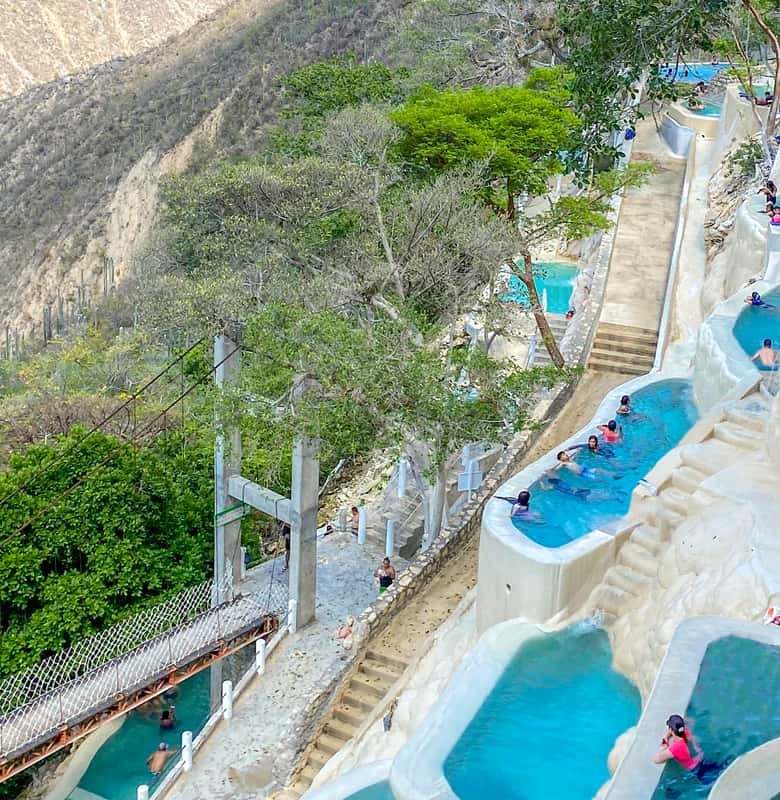
Inside the valley, which is the real advantage of arriving in your own vehicle. There are hotels, cabins, a campsite with grills, and tent-houses for rent, plus mats, blankets and firewood available on site.
Booking is done with the resort rather than through any tour operator. Staying at the resort covers what is available and what the day looks like when you wake up in it.
Where do self-drivers lose the day?
Three places, and all three are avoidable. The first is the start: leaving at eight rather than five costs three hours at the far end and turns a full day into an afternoon.
The second is the shop. Guided departures stop for water shoes and phone pouches as a matter of routine; a self-driver who has not thought about it arrives without either and either buys at resort prices or does without.
The third is the return. Four hours of driving after a day in hot water is a different proposition from four hours of dozing in a van, and it is the reason a lot of self-drivers end up staying the night whether they planned to or not.
What does a guided departure actually remove?
Four things, and it is worth being precise rather than vague about it. It removes the driving, including the descent, in both directions. It removes the gate, because entry is inside the fare on eight of the nine. It removes the shopping problem, because the stop is built into the route. And it removes the decision-making, because somebody who has been down there hundreds of times tells you which pools are worth the walk.
What it does not remove is the four hours of road each way. Nothing does.
When is driving yourself the right call?
When you are staying the night, because the fixed cost of the drive is then spread over two days instead of one. When there are four or five of you sharing fuel, which changes the sum considerably. When you want to arrive the evening before and have the terraces to yourself at seven in the morning. And when a mountain road sounds like part of the holiday rather than the price of it.
When is it not?
When you are doing it in one day. Fourteen hours with four of them behind the wheel at each end, in the dark at one end, is a hard day and the descent is the last thing you want tired.
When you are travelling as a pair, because per-seat fares on the coach departures are low enough that fuel and the gate can add up to more. And when nobody in the group wants to drive it, which is worth admitting out loud before somebody volunteers reluctantly.
Is arriving the night before worth it?
If you are driving, yes, and it is the strongest argument for doing so. Arriving in the evening turns a fourteen-hour day into two comfortable halves, puts you in the pools before the first departures from Mexico City reach the gate at about half past ten, and removes the worst part of the self-drive version — four hours at the wheel after a day in hot water.
There are hotels, cabins, a campsite with grills and tent-houses for rent inside the valley, all booked with the resort rather than through an operator. The pools stay open until eleven at night, and the posted rules are that nobody enters the river after ten and quiet starts at eleven.
Staying at the resort covers what is down there and what you can rent when you arrive, which is more than most people expect.
What if you are coming from the Bajío?
Then the calculation changes, because Mexico City is not on your route. One departure leaves from Querétaro instead, runs twelve hours, caps at five travellers and includes pickup and entry. It is the only guided trip here that does not start in the capital.
Driving from Querétaro is also perfectly feasible, and the same rules apply: check the gate price with the resort, take pesos, and do the descent in daylight if you can.
What to settle before you leave
Five things, and none of them can be fixed once you are at the bottom of the canyon:
- The gate price, confirmed with the resort rather than a travel page.
- Cash in pesos, more than you expect, split between two places.
- Water shoes, or a plan to buy a pair on the road.
- A sealed pouch for your phone, because the steam tunnel has nowhere dry.
- Where you are sleeping, if the answer is not “four hours away, tonight”.
What to bring to Grutas Tolantongo has the full list with rough costs.
Self-drive against a booked seat
| Driving yourself | A booked departure | |
|---|---|---|
| The descent | Yours, both directions | Somebody else's |
| Entry | Paid at the gate, in cash | In the fare on eight of nine |
| Start time | Yours | Fixed, between 4 and 5.45 a.m. |
| Water shoes | Bring them or pay resort prices | Shop stop on most routes |
| Hours on site | As many as you want | About 4 to 7, stated on the listing |
| Staying the night | Straightforward | One departure sells a two-day version |
| The drive home | Yours, after a day in hot water | Sleep |
| Cost for two | Fuel, tolls, gate × 2 | From $79 each, entry included |
| Cost for five | Fuel, tolls, gate × 5 | Five fares |
Two ways to reach the same canyon
What about a hire car?
Workable, and the calculation is the same one with an extra line in it. Check that your rental agreement covers the roads you intend to use and that you are comfortable with the vehicle before the descent rather than during it.
If the answer to either is uncertain, the coach departures cost less per seat than a day’s hire and include the gate.
Does it work out cheaper?
For one or two people, usually not. Fuel and tolls each way plus the gate twice sits close to two coach fares, and the coach fares include entry, a guide and somebody else doing the descent.
For four or five sharing a car it does work out cheaper, and comfortably so, because the fixed costs stop scaling while the fares would have. That is the honest crossover, and it is also roughly the point at which a per-group private departure starts to make sense as the third option.
Add a night in the valley and self-driving wins on both cost and experience, because the drive is then spread across two days instead of bracketing one. What a trip to Grutas Tolantongo costs runs the same sums from the other direction.
What if there are five of you?
Then the arithmetic tips furthest toward driving, and it is worth being explicit about why. Five coach fares is five times $79 before anything else; one car of five is one tank of fuel, one set of tolls and five gate entries. The gap is real.
The counter-argument is the same one as ever: somebody in that car has to drive twenty-three hairpin curves twice in a day, and it will not be the person who suggested it who regrets it. The middle option is the Querétaro departure, which caps at five and includes pickup and entry, if your route happens to pass that way.
Above five, a private vehicle priced per group starts to make sense again, which is the shape of almost every decision here: cheap at one, cheap at five, awkward at three.
The short version
Drive if you are staying the night, if there are four or five of you, or if you actively want the road. Book a seat if you are doing it in a day, if you are travelling as a pair, or if the idea of twenty-three hairpin bends after dark is doing anything other than appealing to you.
Either way, take pesos, take water shoes, and check the gate price with the resort first. How to get to Grutas Tolantongo has the route in detail.
If the road decides it for you, Grutas Tolantongo Tours lists the departures that hand the driving to somebody else, in both directions.
If you would rather not drive it
Three departures that take the road off your hands, from three different starting points.