Itinerary
One Day at Grutas Tolantongo, Hour by Hour
Eight hours of road and four to seven in the water. This is where the time actually goes on a day trip out of Mexico City — and where you can move it.
In this guide
- What does a fourteen-hour day actually look like?
- Why does it start before dawn?
- What happens at El Arenal?
- Is the shop stop worth using?
- What are the twenty-three curves like?
- Should you do the pools or the caves first?
- When is the steam tunnel best?
- How long will you actually spend in the river?
- What do most people run out of time for?
- What happens on the drive home?
- What does the eight-hour version cut?
- Where does a day like this go wrong?
- What does the guide actually do down there?
- The day, hour by hour
- Where does lunch fit into all this?
- Is one day enough?
What does a fourteen-hour day actually look like?
Eight hours of it are road. That is the fact everything else follows from, and it is better faced before you book than at four in the afternoon when you realise the coach leaves in twenty minutes.
The other four to seven hours are the canyon, and how you spend them is almost entirely up to you — guides here point and explain rather than march. Which is why having the shape of the day in your head before you arrive is worth more than any single tip.
Why does it start before dawn?
Because the driving is fixed and the daylight is not. A departure leaving at nine would reach the canyon at one and leave at four, which is not a day out. Leaving between four and half past five puts you at the gate by mid-morning with the whole afternoon below the rim.
Door pickups on the car and private departures start around 5.45 a.m. Coach departures meeting at a fixed point in the centre start earlier. If you are staying outside the historic centre, that difference is an hour of sleep.
What happens at El Arenal?
About two and a half hours out, most departures stop at a roadside kitchen in El Arenal, Hidalgo. On four of the nine it is included in the fare. Travellers mention this stop more than any other part of the drive, which tells you something about both the food and the hour.
It is also the last proper meal before the canyon on most trips, since lunch is rarely included and the restaurants inside the valley are cash only.
Is the shop stop worth using?
Yes, and on some departures it is the difference between a good day and a sore one. The shop at San Miguel Tlazintla sells water shoes at roughly 100 to 150 pesos and waterproof phone pouches at roughly 50 to 120, along with towels, snacks and drinks.
Not every departure stops there. If yours does not, buy both before you leave the city. What to bring to Grutas Tolantongo lists what is worth carrying and what can wait for the road.
What are the twenty-three curves like?
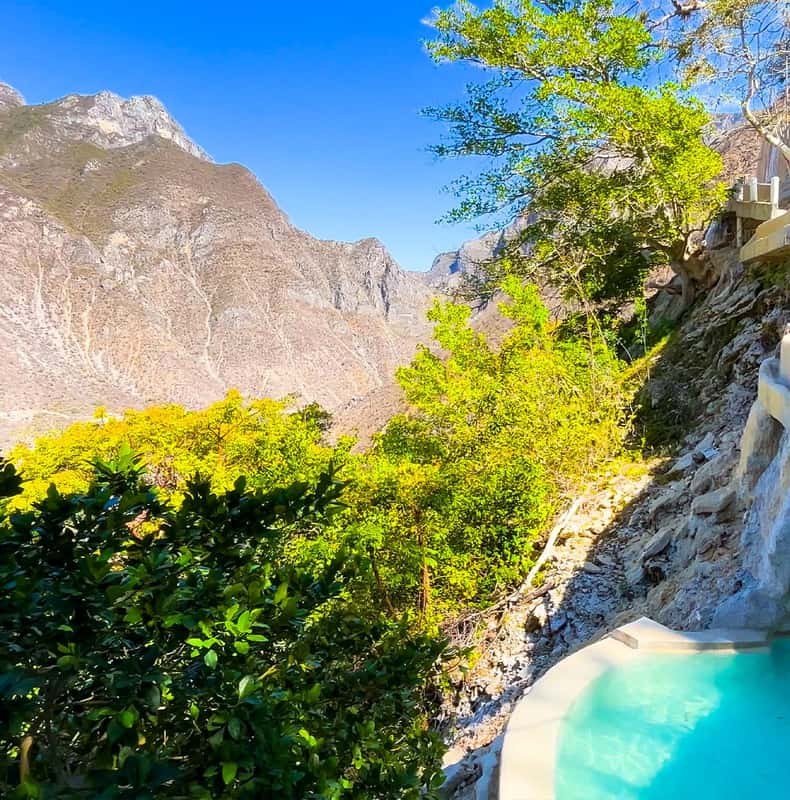
A genuine mountain descent, switchbacking down the canyon wall from the rim to the pools. Before it, most trips stop at the Gran Cañón de Tolantongo viewpoint, where the valley opens up below the road with a small chapel beside it — the only place you see the whole thing at once.
In a vehicle it takes about half an hour and it is the part of the drive people photograph. Behind the wheel it is the part that persuades a lot of visitors to book a seat next time.
Should you do the pools or the caves first?
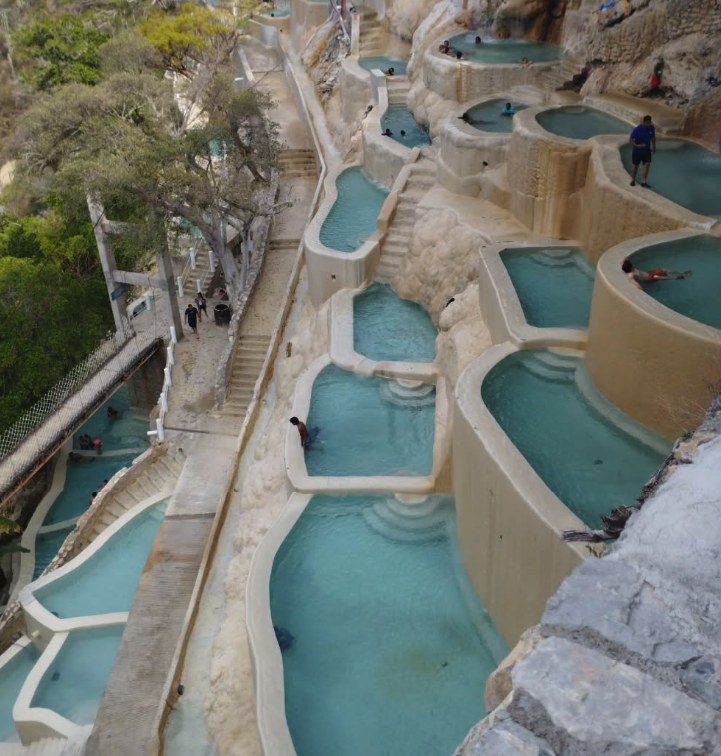
The caves, if you have any say in it. Almost everybody arrives, sees the terraces from the road and walks straight down to them, so the pools fill from the top of the day while the grotto and the tunnel stay quiet until mid-morning.
There is a physical argument too. The descent to the valley floor is a long flight of wet steps and you climb back up at the end of the day, after hours in hot water. Doing the low ground first means the climb happens once.
When is the steam tunnel best?
Late morning, and not for long. Forty metres held at about 40 °C behaves exactly as that sounds: twenty minutes is plenty, and much more than that leaves you wanting to lie down at precisely the moment the day asks you to climb.
Take nothing in you would mind losing. There is nowhere dry inside to put anything down, which is what the phone pouch is for.
How long will you actually spend in the river?
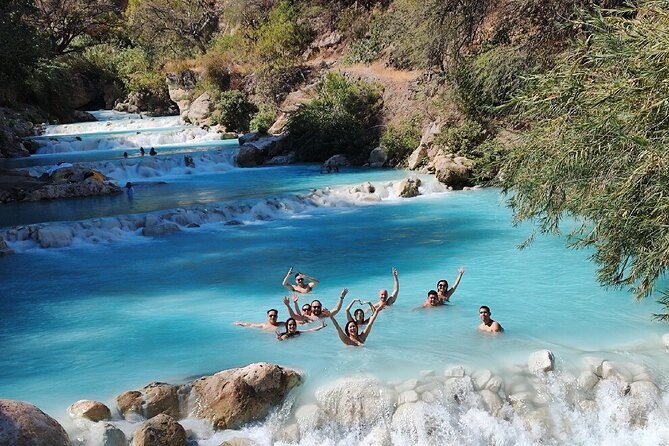
Longer than you plan to. The thermal river runs warm between white boulders, wide enough to sit down in and shallow enough to cross, and it is the easiest place in the canyon to lose an hour without noticing.
Treat it as a warm-up on the way in rather than the destination, and come back to it at the end if there is time. Pool by pool sets out a route that accounts for this.
What do most people run out of time for?
Las Pocitas, across the valley. Reaching it means a shuttle that charges a small fee each way or a walk of about twenty-five minutes, and on a four-hour departure it simply does not fit.
Cut it early rather than discovering at three o’clock that the day has gone. And if Las Pocitas or La Gloria are what you came for, that is a decision made when you book rather than on the day — the map of the canyon shows why they are separate places rather than sections.
What happens on the drive home?
Four to four and a half hours, most of it asleep. One trip adds a pulque tasting on the way back when the weather lets the van down to the area, and one includes dinner at drop-off.
You will reach the city between about nine and eleven at night having been awake since four. Leave the evening empty and treat the next morning as a slow one.
What does the eight-hour version cut?
Almost none of the canyon, and almost all of the waiting. The private departure that runs eight hours instead of fourteen does not drive faster; it stops collecting other travellers, stops waiting for a group to reassemble at each stop, and stops running to somebody else’s return time.
What it does compress is the road stops. A shorter day means less time at breakfast and less time at the shop, so anything you were planning to buy on the way is better bought before you leave the city. And because the fare is charged per group rather than per seat, the arithmetic only works once there are two of you.
It is the departure to look at if your days in Mexico City are counted, and the one to skip if they are not, because six hours of van time is not what anybody is actually paying to avoid.
Where does a day like this go wrong?
Four places, and all four are decided before you arrive rather than on the day.
The first is cash. Turning up with a card and no pesos means no locker, no lunch, no shuttle and no zip line, in a valley with no cash machine. The second is footwear: the grotto is entered through water and the steps are wet, and a pair of water shoes bought at the roadside shop for around 100 pesos solves it entirely.
The third is the evening you booked for afterwards. You will be back between nine and eleven at night having been awake since four. The fourth is expecting to see everything — on four hours below the rim you are choosing between the far side of the valley and sitting still, and the people who enjoy the day most choose in advance. The questions page covers the rest of what travellers ask before they come.
What does the guide actually do down there?
Less than you might expect, and that is the right answer for this site. Guides on these trips do not march a group between numbered stops. They get you into the canyon, explain what each section is and roughly how long it takes, point out which pools are worth the climb, and then leave you to it until a stated time.
What they are useful for is the things that are hard to work out alone: which of the two caves to do first, where the shuttle to Las Pocitas leaves from, whether the river is running clear today, and where to stand for the photograph everyone takes. Travellers name individual guides in their reviews unusually often, which says something about how these operators run.
Eight of the nine departures include a guide in the fare. One is described as a host or greeter rather than a guide, which is a real distinction worth reading before you book.
The day, hour by hour
| Roughly | Where | What it costs you to skip |
|---|---|---|
| 4:00–5:45 a.m. | Pickup or meeting point | Nothing — but you cannot skip it |
| 7:00–7:30 a.m. | Breakfast at El Arenal | A hungry morning; it is often included |
| 8:00 a.m. | Shop stop, San Miguel Tlazintla | Water shoes at zero pesos, and sore feet |
| 9:00 a.m. | Gran Cañón viewpoint | The only whole-valley view of the day |
| 9:30 a.m. | The twenty-three curves | — |
| 10:00 a.m. | River, grotto and steam tunnel | The quietest hours in the caves |
| 12:30 p.m. | The terraces of Paraíso Escondido | The reason most people came |
| 2:30 p.m. | Las Pocitas, if you have the hours | The quiet half of the site |
| 4:00 p.m. | The climb, and the road | — |
| 9:00–11:00 p.m. | Back in Mexico City | Tomorrow morning |
A fourteen-hour departure, in order
Times are the shape of a typical departure rather than a timetable. The eight-hour private trip compresses everything except the driving.
Where does lunch fit into all this?
Awkwardly, which is why it is worth deciding in advance. Breakfast is included on four departures and eaten on the road at El Arenal. Lunch is included on almost none, and the restaurants inside the valley take cash rather than cards.
Two options work. Buy inside, at the restaurant area near the suspension bridge, which costs a little time and no planning. Or carry food in and eat between the pools, which costs no time at all and means one less thing to find. Either way, carry pesos.
The exception is the trip built around Hidalgo cooking, which includes breakfast and dinner at either end and treats the meals as part of the point rather than refuelling.
Is one day enough?
For the main canyon, yes, provided your departure gives you five hours or more below the rim. For the whole valley — the main terraces, Las Pocitas and La Gloria — no, and no departure pretends otherwise.
Travellers raise this without being asked. More than one who did it in a single day said they would give it two, and one departure sells both versions of itself so you can compare like with like. Day trip or overnight works through what the second morning buys.
Every mexico city to grutas de tolantongo tour runs some version of the day above; what changes is how many of its hours you spend below the rim.
Departures that give you the most of that day
The three with the longest stated time below the rim, and the one that adds a second valley.