
Grutas Tolantongo Pool by Pool
Why the order matters here
This is a canyon, not a pool complex. Everything is either above you or below you, and the only flat walking is the valley floor beside the river. The two halves of the site are close in distance and far apart in effort, which is why the sequence you take them in changes how the day feels.
There is a second reason. The caves and the tunnel are the parts that fill up, because everybody arrives, sees the terraces from the road and goes straight to them. Reversing that buys you the grotto with room to move in it.
Stop 1 — the thermal river
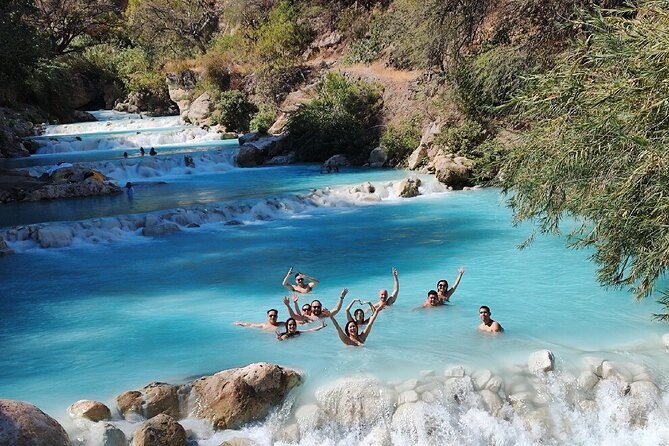
Start on the valley floor. The river runs opal turquoise between white boulders, warm, wide enough to sit down in and shallow enough to cross on foot. Its colour comes from lime and magnesium released by the rock, which is also what has built the pale terraces above you.
It is the easiest place in the canyon to lose an hour, so treat it as a warm-up rather than the destination. Twenty minutes here sets you up for the cave.
Stop 2 — the main grotto
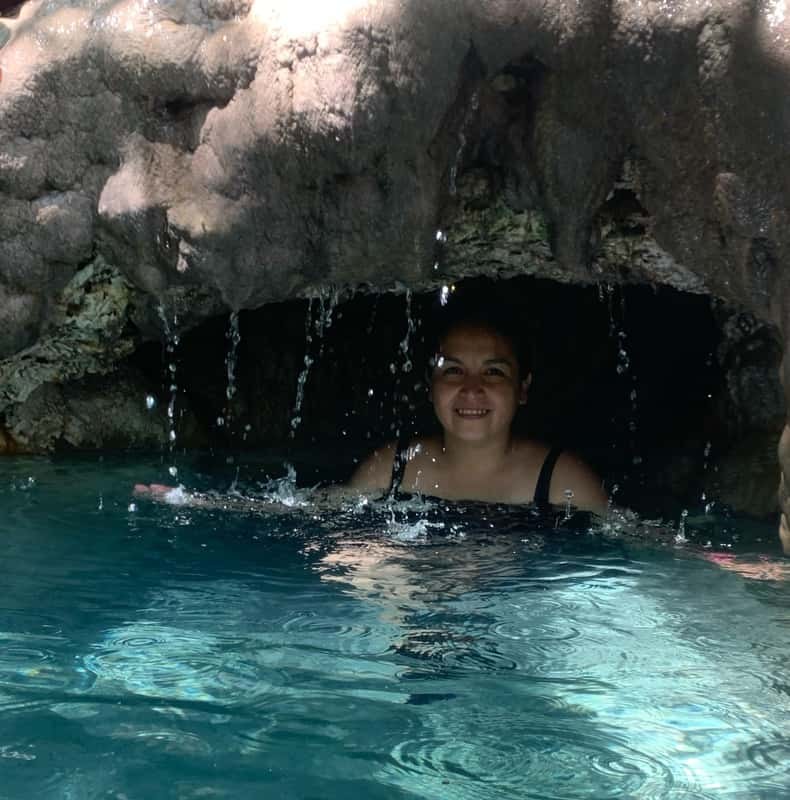
The cave the river rises in. Inside there are stalactites and stalagmites, a waterfall that falls within the cave itself, and a horsetail cascade at the mouth. You do not walk in; you get in and swim, which is the moment every packing list on the road is written for.
Go now, before the middle of the day. Take nothing you would mind losing and nothing that is not in a sealed pouch.
Stop 3 — the Túnel de Vapor
Forty metres of tunnel held at around 40 °C by the rock itself, working like a natural steam room. You wade rather than walk, in low light, with heat rising off the water. It is the part first-time visitors describe afterwards more than the pools.
Twenty minutes is plenty. Longer than that and you will come out wanting to lie down, which is inconvenient because the next stop is upstairs.
Stop 4 — the suspension bridge
Slung across the Túnel del Paraíso, with the pools below and the canyon dropping away on both sides. It is a short crossing and a long photograph. The restaurant area and the zip line sit on the same stretch, so this is the natural place to eat if you are buying lunch.
Stop 5 — Paraíso Escondido
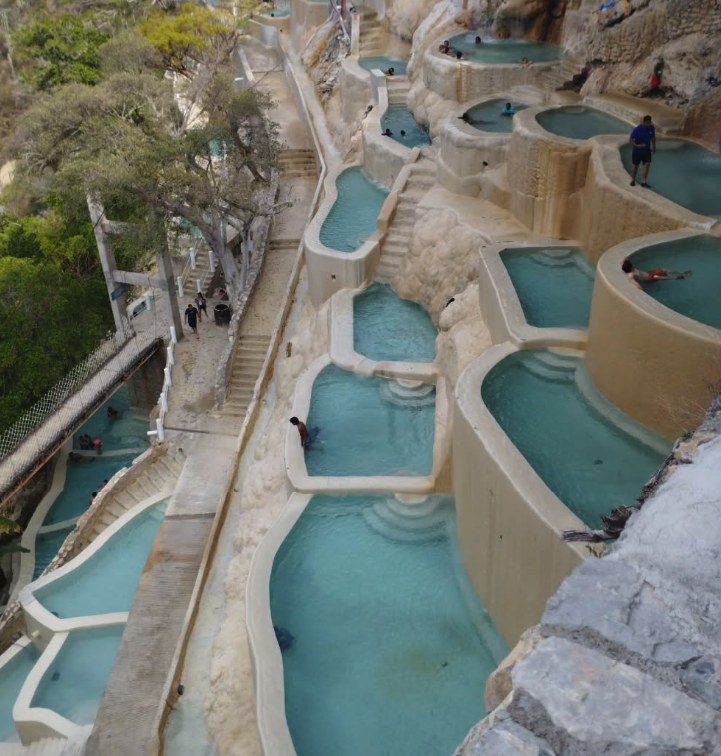
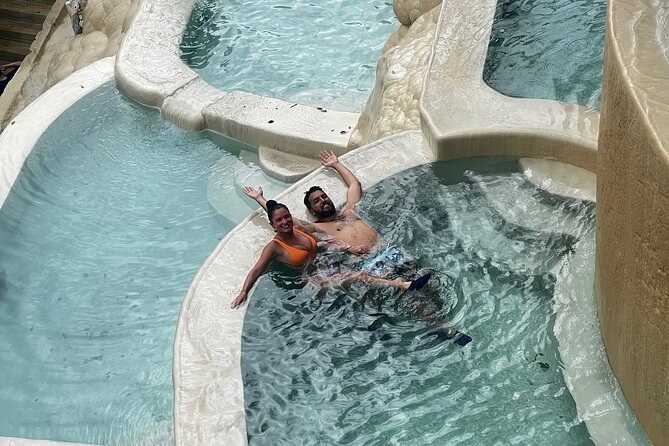
Now climb. More than forty pools stepped down the cliff on their own travertine terraces, each spilling into the one below, one of them fed by a slide. The lowest sit level with the treetops with the drop beyond the lip.
This is where the rest of your time goes, and it should be, because it is the part you cannot rush and would not want to. Pick a terrace and stay on it; the pools are more alike than the photographs suggest and the view changes more than the water does.
Stop 6 — Las Pocitas, if you have the hours
A separate set of shallower built pools across the valley, with a slide, a second suspension bridge and a water grotto of its own. Reaching it means a shuttle, which charges a small fee each way, or a walk of about twenty-five minutes.
It is quieter than the main terraces precisely because getting there takes a decision. On a busy Saturday that is worth the walk on its own — but only if your departure gives you five hours or more.
What most visitors walk past
- The travertine itself. The pale rock around the pools is not concrete. It is limestone the spring has laid down over a very long time.
- The horsetail cascade at the grotto mouth, which most people swim under without looking up.
- The Gran Cañón viewpoint on the way in, with its small chapel — the only place you see the whole valley at once.
- The pools after dark. If you are staying over, the bridge is lit and the water is warmer than the air.
The route, timed
| Order | Where | Plan for | Why here |
|---|---|---|---|
| 1 | The thermal river | 20 minutes | Warm up, and it is on the way in |
| 2 | The main grotto | An hour | Quietest early, and it needs energy |
| 3 | The Túnel de Vapor | 20 minutes | Next door to the grotto |
| 4 | The suspension bridge | 15 minutes | On the climb back up |
| 5 | Paraíso Escondido | The rest of your time | The part you will not want to leave |
| 6 | Las Pocitas | Half a morning | Only with 5+ hours on site |
Times assume you are not queueing. On a holiday weekend, add to every line.
What the route asks of you physically
It is worth being clear about this because photographs flatten it. The descent from the road to the pools is a long flight of steps, wet in both directions, and you climb it at the end of the day rather than the start — after several hours in hot water, which is when steps feel longest.
Between the river and the terraces there is more climbing. Between the terraces and Las Pocitas there is either a twenty-five minute walk or a shuttle that charges a small fee each way, in cash. None of it is technical and all of it is cumulative. Shoes with grip and a slow pace at the end are the whole trick. What to bring covers the footwear question properly, and hours and access sets out what the ground is like before you commit.
Where the crowds actually are
They are not spread evenly, which is what makes the reversed route work. Almost everybody arrives, sees the terraces from the road and walks straight down to them, so the pools fill from the top of the day and the caves stay quiet until mid-morning.
Las Pocitas, across the valley, is the reliably quiet option at any hour, because reaching it takes a deliberate decision rather than a drift. And if the main canyon is busy on a holiday weekend, the cave, the tunnel and the pools names the sections worth holding out for.
If you only have four hours
Cut Las Pocitas, and cut it early rather than discovering at three o’clock that you have run out of day. Four hours does the river, the grotto, the tunnel and the terraces at a brisk pace, which is a complete visit and a good one. What it does not do is leave room to sit still, and sitting still is most of what people came for. Hours and access lists which departures give you more.
Book the trip this post describes
Chosen for what is covered above, not for what sells.
Private Tour of Tolantongo Grottoes with Transportation from CDMX
From $666 per group (up to 2)
Check Availability