12 Facts About Grutas Tolantongo
1. The turquoise is dissolved rock, not algae
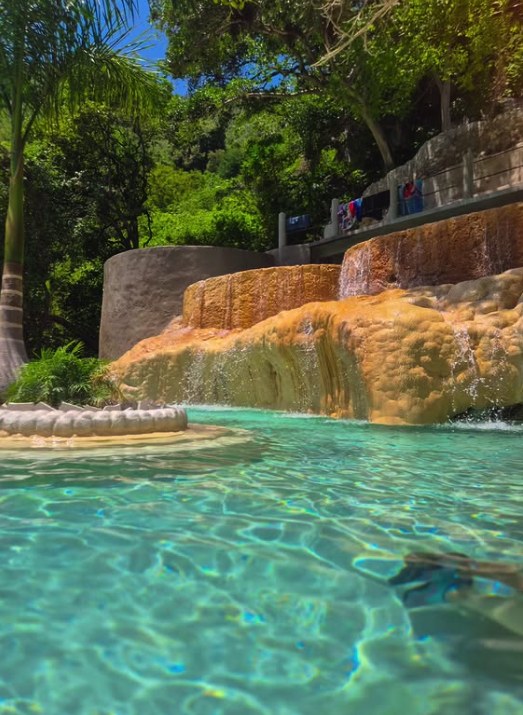
The colour comes from lime and magnesium released by the rock the springs pass through. It is a mineral load in suspension, which is why the water reads opaque rather than clear, and why it looks milky where the river runs shallow over stone.
2. The terraces are built by the water itself
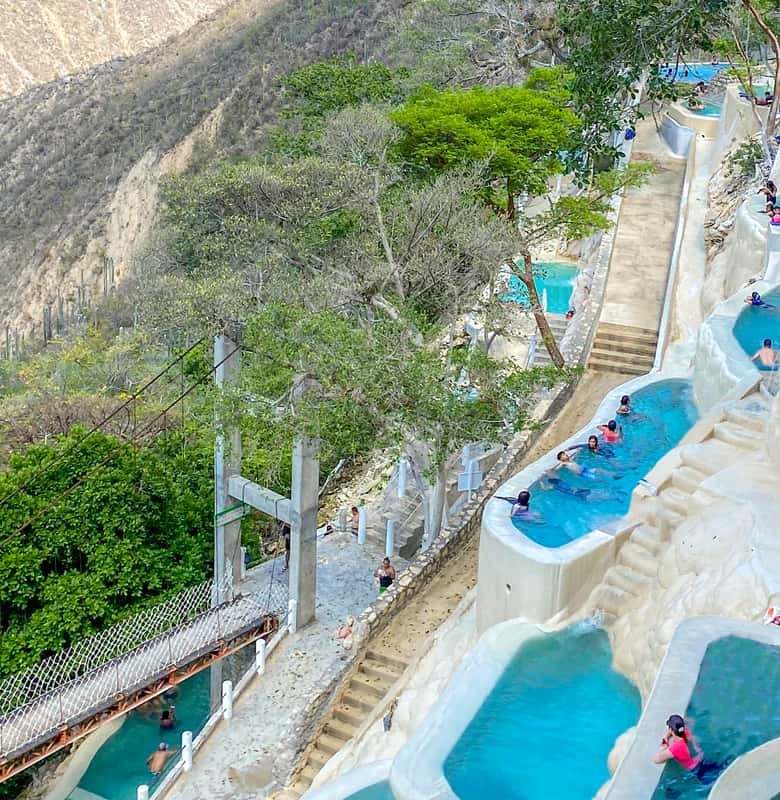
The pale, poured-looking rock around the pools is travertine — limestone the spring has laid down over a very long time. What looks like a concrete lip on a terrace is often the water's own work.
3. The river changes colour with the season
After heavy rain, currents coming off the mountains can turn the river from turquoise to brown for a stretch of days. It settles when the rain does. This one genuinely changes when to come, and almost no guide mentions it.
4. There is a tunnel that behaves like a sauna
Forty metres long, held at around 40 °C by the rock itself. You wade through it rather than walk, in low light. It is the part first-time visitors talk about afterwards more than the pools they came for.
5. You swim into the cave, you do not walk in
The main grotto holds the source of the river, a waterfall that falls inside the cave and a horsetail cascade at the mouth. Entry is through water. That single fact is why every operator on the road puts water shoes at the top of the packing list.
6. The pools sit at 1,280 metres
High enough that the sun is stronger than it feels and the evenings are cooler than the afternoon suggests. Shade in the canyon is limited, which is why two operators specifically ask for biodegradable sunscreen — the water you are swimming in is the river.
7. The road in has twenty-three hairpin curves
The descent from the rim to the pools is a genuine mountain road. It is the single most-discussed part of the journey and the reason a large share of visitors book a seat rather than drive.
8. The zip line is close to two kilometres long
Described by the operators as the longest in Hidalgo, it crosses the valley from the bridge area. It is in no tour fare and costs about 200 pesos on the day, which surprises people who assumed a guided trip covered everything.
9. Card payment barely works down there
Almost nothing inside the resort takes credit or debit cards. Lockers, food, the shuttles and the zip line are all pesos in cash, and there is no cash machine at the bottom of the canyon. It is the most common practical mistake visitors make.
10. There is a whole resort in the canyon, not just pools
Hotels, cabins, a campsite, tent-houses for rent, restaurants, shops, showers, changing rooms and a medical post. You can rent mats, blankets, firewood and aquatic clothing on arrival, which is useful if you flew in with hand luggage. Staying at the resort has the detail.
11. The pools stay open until eleven at night
The canyon runs from seven in the morning to eleven at night, every day. Two rules are posted at the entrance in Spanish and English: nobody enters the river after ten, and music and loud noise stop at eleven. Day trips are long gone by then; anyone staying over has the terraces after dark with the bridge lit.
12. La Gloria is a different valley with its own entrance
Further up, with its own pools, waterfalls, viewpoints and a river source with a pool six metres across. Most day trips never reach it. Two departures out of Mexico City are built around it instead of the main canyon, which is the only realistic way to see it in a day.
Three more that surprise people
The whole site runs on cash, deliberately
It is not that card machines are broken. There simply is not the infrastructure at the bottom of a gorge four hours from the nearest city of size, and the resort has never pretended otherwise. Plan for a cash economy and it is frictionless; arrive with a card and it is not.
There is a medical post on site
Not something every canyon of this kind can say, and worth knowing before a long day in hot water at altitude. Bring your own personal medication anyway; it is a first-aid post, not a pharmacy.
You can rent almost everything you forgot
Mats, blankets, firewood, aquatic clothing and tent-houses are all available on arrival, which makes an overnight stay far easier to improvise than most people assume. Lockers too — rented, in pesos, and never included in a tour fare. Traveller reviews mention the locker question more than almost anything else.
Two the photographs never tell you
It is bigger than the frame suggests
Almost every photograph of Tolantongo is one of two shots: the aerial of the terraces, or the stepped pools from the path above them. Both crop out the scale. The site runs from a viewpoint on the rim, down twenty-three curves, along a valley floor with a river in it, up a cliff of pools, and across to a second set on the far side. Walking between the ends of it is a real part of the day.
The pools are more alike than the terraces are
What changes as you climb is not the water but the view over the lip. That is worth knowing because it settles the most common question people ask themselves down there — whether to keep moving up the terraces or pick one and stay. Pick one and stay.
The four that change your plans
| Fact | What to do about it |
|---|---|
| The river browns after heavy rain | Pick a dry-season date if the colour matters to you |
| Cards barely work inside | Draw pesos before you leave the city, and bring extra |
| You swim into the grotto | Water shoes and a sealed phone pouch, bought on the road if needed |
| La Gloria has its own entrance | Book a departure that goes there, or plan a second visit |
The rest are worth knowing. These four cost you something if you do not.
For the named parts of the canyon and what each one actually is, see the cave, the tunnel and the pools. For the road in, including the twenty-three curves, how to get there has it stop by stop.
Book the trip this post describes
Chosen for what is covered above, not for what sells.