How to Visit Grutas Tolantongo
Where it is, and why that shapes everything
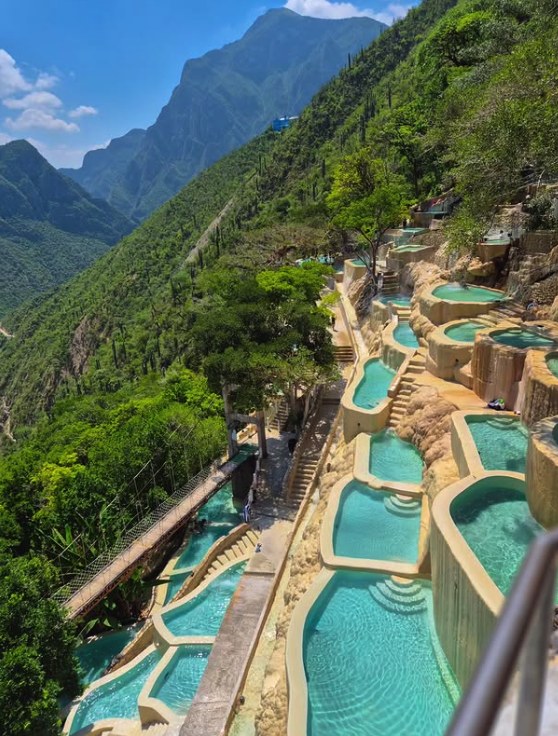
Grutas Tolantongo sits at San Cristóbal in the municipality of Cardonal, in the Mezquital Valley of Hidalgo. It is roughly four hours by road north of Mexico City, and the last part of the road drops into the canyon through twenty-three hairpin curves.
That descent is the single fact that decides how most people travel. There is one way in and it ends at the bottom of a gorge, which is why a fourteen-hour day trip is the normal shape of a visit and why so many travellers hand the driving to somebody else. How to get to Grutas Tolantongo covers the route stop by stop.
When it is open
Every day, from seven in the morning until eleven at night. Two rules are posted in Spanish and English at the entrance and matter only if you are staying over: nobody enters the river after ten at night, and music and loud noise stop at eleven.
Tickets: what a tour fare covers
Eight of the nine guided departures include entry to the canyon in the fare and itemise it on their own listing. That is the number to check first when two prices look far apart, because a cheaper trip that leaves entry to you is not actually the cheaper trip.
| What | In the fare? | Paid on the day |
|---|---|---|
| Entry to the canyon | On eight of nine trips | — |
| Return transport from the city | On all nine | — |
| A guide | On eight of nine | — |
| Breakfast on the road | On four trips | On the rest |
| Lunch | Rarely, and stated when it is | Usually |
| Lockers | Never | Always, in pesos |
| The zip line | Never | About 200 pesos |
| Shuttle to Las Pocitas | Never | A small fee each way |
Every card states which of these its own listing covers.
If you are driving in and paying at the gate instead, check the current price with the resort before you set off rather than trusting a figure copied from a travel page. Rates change without notice, and there is no cash machine at the bottom of the canyon.
Getting there, three ways
- A coach departure. Meets in central Mexico City, fourteen hours, the lowest fare, entry included.
- A car of four. Collected from your accommodation, breakfast on the road, about an hour more on site.
- A private vehicle. Eight hours door to door, priced per group, hotel pickup at both ends.
Driving yourself is the fourth option and it is a perfectly good one for a confident driver with a free weekend. It puts the twenty-three curves in your hands in both directions, which is exactly the trade.
How long to allow, and what four hours really means
Time on the canyon floor is what separates these trips, and it runs from about four hours to seven. It is the single most useful number on any card, and it is invisible on a price-sorted list.
| Hours on site | What that covers | What it does not |
|---|---|---|
| About 4 | The cliff pools and one cave | Las Pocitas, and any sitting about |
| About 5 | Pools, grotto, tunnel, some river | The far side of the valley |
| About 5.5 | All of the main canyon, comfortably | La Gloria |
| About 6–7 | The main canyon at a walking pace | Still not La Gloria |
La Gloria has its own entrance and is a separate trip rather than a section of this one.
The three things first-timers get wrong
1. Assuming a card will work
It will not, or not reliably. Lockers, food, drinks, the shuttles and the zip line are all cash in pesos, and the operators say so on their own listings. Draw money before you leave the city and split it between two places.
2. Treating four hours as the whole day
A fourteen-hour trip is mostly road. Knowing before you arrive whether you want the pools or the caves first is what stops the afternoon disappearing while you decide.
3. Arriving without water shoes
The rock is wet, uneven and in places sharp, and the main grotto has to be entered through water. Most departures stop at a shop in San Miguel Tlazintla where a pair costs roughly 100 to 150 pesos — but only if your trip makes that stop.
What you will actually see
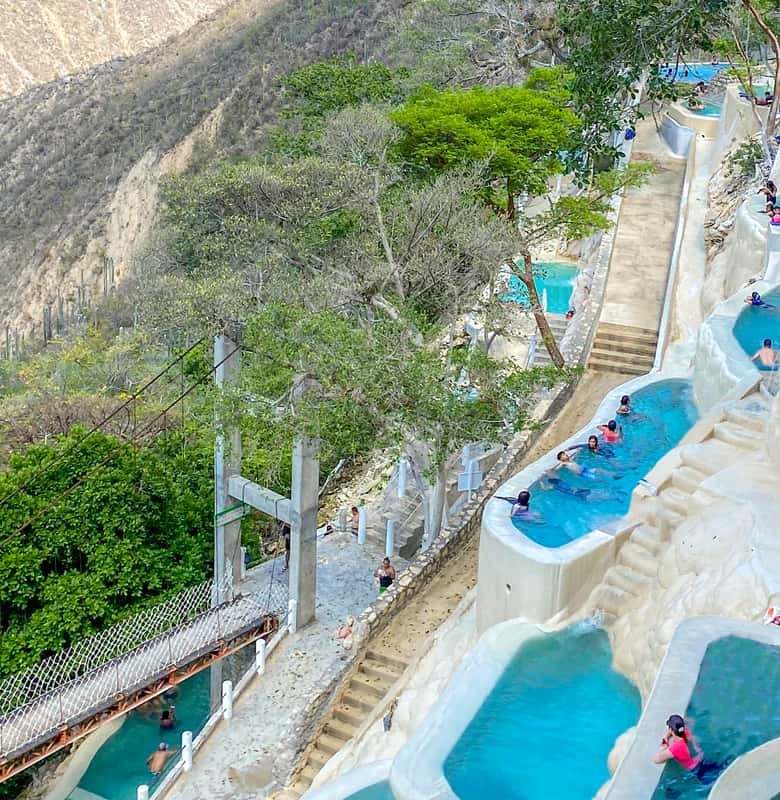
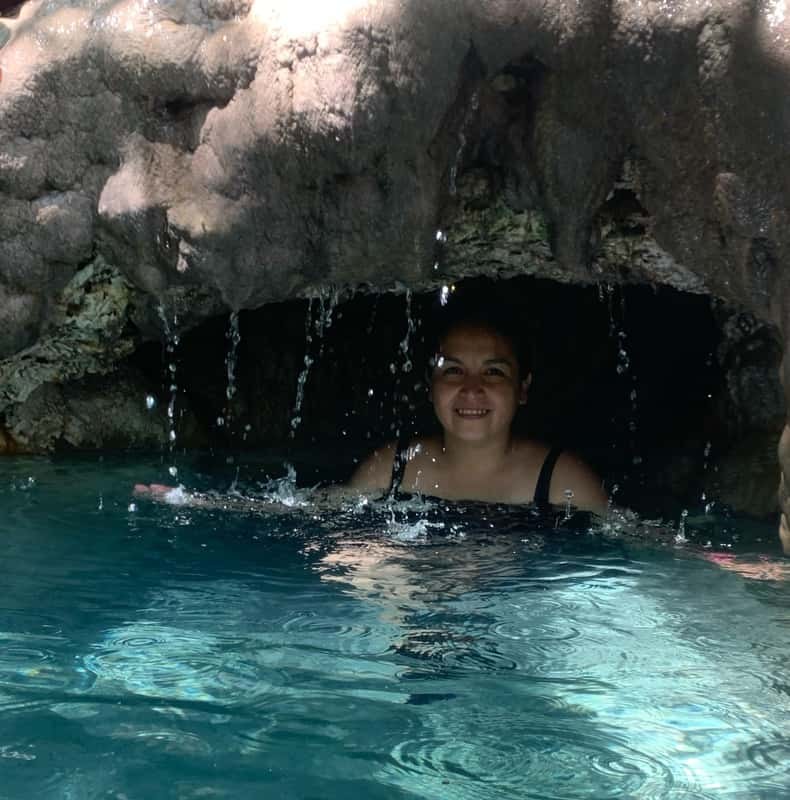
Six named places, and they are not variations on each other: the cliff pools of Paraíso Escondido, the main grotto where the river rises, the forty-metre steam tunnel held at about 40 °C, the thermal river itself, the suspension bridge, and Las Pocitas across the valley. The cave, the tunnel and the pools describes each one and how long it realistically takes.
Where to eat, and what is down there
There are restaurants inside the valley and shops selling food and drink, so nobody goes hungry — but almost none of it takes a card. Several departures also build a roadside breakfast into the fare on the way up, and two add a meal at drop-off in the evening.
The canyon is a working resort rather than a viewpoint: hotels, cabins, a campsite, showers, changing rooms and a medical post are all inside it, and you can rent mats, blankets, firewood and aquatic clothing on arrival. Staying at the resort covers what is available, including for anyone thinking about a second day. If you are trying to picture how the pieces fit before you arrive, the map of the canyon lays out the two valleys.
Accessibility, plainly
Not one of the nine guided trips describes itself as wheelchair accessible. Several also advise against travelling with back problems, during pregnancy or with a heart condition, and one lists non-swimmers among the people it does not suit. The descent is a long flight of wet steps in both directions.
If mobility is the deciding factor, ask the resort what the level areas are before committing to a fourteen-hour day, and look at the eight-hour private departure rather than a coach: a vehicle you control means you set the pace at both ends.
The day, start to finish
- Before dawn. Pickup or meeting point in Mexico City, between about 4 and 5.45 a.m.
- Two and a half hours out. Breakfast at a roadside kitchen in El Arenal.
- The shop stop. San Miguel Tlazintla, for water shoes and a phone pouch.
- The viewpoint. Gran Cañón de Tolantongo, and the first sight of the valley.
- The descent. Twenty-three curves down.
- Four to seven hours below. Pools, grotto, tunnel, river.
- Back up, and home. Arriving in the city between about nine and eleven at night.
Plan the following morning as a slow one. Travellers who booked something for the evening they got back consistently wish they had not.
Booking, and what to check before you pay
Every trip listed here refunds in full up to 24 hours before departure, which is unusual across a field of nine and worth using if the forecast looks unsettled. Most also let you reserve now and pay nothing today.
Four things are worth checking on the specific departure rather than assuming:
- Hours on site. Four and seven are very different days.
- Whether entry is in the fare. Eight of nine say so; one does not.
- Whether it makes the shop stop. That is where water shoes cost 100 pesos rather than nothing at all.
- Whether it needs a passport. One operator asks every traveller for one.
If a question is not answered on the card, it is probably answered on the questions page, which collects what people actually search for before they come. What other travellers made of each departure — criticism included — is on the reviews page.
Book the trip this post describes
Chosen for what is covered above, not for what sells.